Few ski resorts can promise reliable snow in early winter and still deliver superb skiing in spring. Tignes can, and that is why skiers return to this high corner of the French Alps year after year. The village sits so high that snow often falls here while lower resorts wait for it, and the glacier above it keeps the skiing going long after other mountains turn green.
Planning Tignes ski holidays for the 2026/27 season raises plenty of questions. When should you go? What will the weather feel like? Where do you find a trustworthy piste map? Which events will run during your stay? This guide answers every one of them in plain language. You will learn how the weather changes from December to April, how to read the snow report, how to use the ski map, which events deserve a place in your diary, and how to choose the right place to stay. By the end, you can book your trip with confidence.
Table of Contents
Why Tignes Is a Top Choice for Ski Holidays
Reliable Snow at High Altitude
The resort sits in the Savoie region, and most of its villages lie above 1,800 meters. Some sit above 2,000 meters. That height keeps temperatures low, so the snow stays in good shape for longer. Many lower resorts struggle in early December and again in late March. Tignes rarely faces the same problem, because its slopes climb all the way to a glacier.
This reliability matters when you book months in advance. You cannot predict the weather, but you can pick a resort that gives you better odds. Altitude gives you those odds.
A Huge Shared Ski Area
Tignes joins forces with its neighbor Val d’Isère to form a ski area called Espace Killy. One lift pass opens roughly 300 kilometres of pistes, so you never run out of new runs to try. You can ski between both resorts in a single day and enjoy quiet village evenings in one place and livelier après-ski in the other.
Who Enjoys It Most
Intermediate skiers love the long, smooth cruising runs. Beginners find gentle slopes close to the villages. Experts head for steep terrain and off-piste lines, always with a qualified guide. Freestyle fans enjoy the snow parks and the big-air events that the resort hosts each winter. Families, couples, and groups of friends all find something to enjoy.
Tignes Villages and Where They Sit
Tignes is not one single village. It is a group of five neighborhoods, and each one has its own feel. Your choice shapes your whole holiday, because it decides how far you walk to the lifts and how lively your evenings feel.
| Village | Approx. altitude | Best for |
|---|---|---|
| Le Lac | 2,100 m | Shops, restaurants, lakeside walks |
| Val Claret | 2,100 m | Glacier access, nightlife |
| Le Lavachet | 2,100 m | Quick lift access, apartments |
| Les Boisses | 1,800 m | Quiet stays, traditional feel |
| Les Brévières | 1,550 m | Calm evenings, lower prices |
Le Lac and Val Claret
Le Lac works as the main hub. It has a lake, shops, restaurants, and a busy center. Val Claret sits a short distance away and gives you direct access to the Grande Motte funicular, which carries skiers up towards the glacier. Visitors who want to ski hard and go out at night often choose one of these two areas.
Le Lavachet
Le Lavachet sits between the two main centers. It suits travellers who want quick access to the lifts and do not mind a slightly quieter setting. Many apartments here put you within a few minutes of the slopes.
Quieter Lower Villages
Les Boisses and Les Brévières suit people who prefer peace. These villages sit further from the main lifts, so you may use a shuttle bus or a short ski run to reach the action. In return, you often enjoy calmer evenings, lower prices, and a more traditional mountain feel.
Tignes Weather Through the Winter
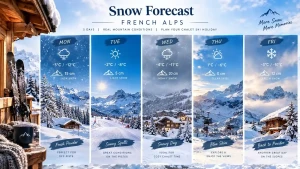
Mountain weather shapes every ski holiday. Here, high altitude means cold, dry snow and long stretches of sunshine, but storms can also roll in fast. Knowing what to expect in each month helps you pack well and pick the best dates.
Month-by-Month Guide
| Month | Typical conditions | Good to know |
|---|---|---|
| Late November | Cold, early season | High slopes open first; terrain stays limited. |
| December | Cold, snowy, short days | Busy at Christmas and New Year |
| January | Coldest month, deep snow | Best for powder, the Mountain Shaker takes place. |
| February | Cold, good snow, more sunshine | Strong demand in school holidays |
| March | Milder, long sunny days | Great all-round skiing, world championships |
| April and May | Warm afternoons, soft snow | Best on high slopes, quieter resort |
Temperatures and What to Wear
Daytime temperatures in midwinter often sit below freezing, and the wind can make the lifts feel even colder. Wear three layers: a warm base layer, a fleece or light down jacket, and a waterproof outer shell. Bring goggles for snowy days and sunglasses for bright ones. Add sun cream too, because the sun is strong at altitude and the snow reflects it back at your face.
Common Weather Mistakes
Many visitors check the forecast for the village and ignore the weather higher up. The summit can feel several degrees colder than the base, and the wind often picks up above the tree line. Another mistake is skipping sun protection on cloudy days. Cloud does not block ultraviolet rays, so you can still burn.
How to Read the Tignes Snow Report
The snow report tells you what the mountain looks like today. A good report shows snow depth at different heights, the number of open lifts and pistes, the latest snowfall, and the avalanche risk level. Riders who read the snow report every morning make smarter choices about where to ski.
What the Numbers Mean
Snow depth at the base and at the top station can differ a lot. A deep top station with a thin base means the upper slopes feel great, but the runs back to the village may feel patchy. Look at both numbers before you plan your day. Also check the avalanche level, because it affects where you can ski safely off the marked runs.
Why Live Data Beats Any Guide
Snow conditions change by the hour. This guide explains the general pattern, but the official snow report gives you the current picture. Treat the report as your daily planning tool and this guide as your long-term plan.
Tignes Piste Map and Ski Map Explained
The piste map shows every lift, run, and mountain restaurant in the ski area. Many people call it the ski map, and both names mean the same thing. Learning to read it saves you time and keeps you on runs that match your level.
Piste Colors and Difficulty
France uses four colors. Green runs are very easy, blue runs are gentle, red runs are steeper, and black runs are the hardest. Remember that the color rate difficulty is inside one resort, not across all resorts. A red run in Tignes can feel easier or harder than a red run somewhere else. Test yourself on a run one grade below your level on your first morning.
How to Plan a Day With the Map
Start by finding your lift station, then trace a route towards the area you want to ski. Pick a lunch spot halfway through the day so you never rush. Note the last lift times, because missing the final lift can leave you with a long walk or an expensive taxi. Save a digital copy on your phone, since the mountain signal can drop.
Linking With Val d’Isère
The map shows how the two resorts connect. Several lifts and runs carry you across, so plan your return early in the afternoon. Many skiers cross over in the morning, spend the day in Val d’Isère and come back before the lifts close.
Tignes Webcams: Check the Mountain Before You Go
Live webcams give you a real-time view of the slopes, the villages, and the glacier. They show cloud cover, snowfall, and crowds. Check a few cameras at different heights before you choose where to ski. A clear view at the base does not guarantee clear skies at the top, so never rely on a single camera.
Webcams also help before you travel. Watching the snow build up in the weeks before your trip gives you a feel for the season and helps you decide what to pack.
Tignes Events in the 2026/27 Season
Two major events shape the winter calendar. They happen almost two months apart, so you can pick the one that matches your holiday dates.
Mountain Shaker, 17 to 22 January 2027
Mountain Shaker is a freestyle festival with concerts, film screenings, and competitions. The 2027 edition is the sixth, and organizers moved it to January for the first time because Tignes hosts a world championship in March. The Big Air competitions for skiers and snowboarders run from 20 to 22 January at the Grande Motte snow front in Val Claret. Watching top athletes launch off a huge jump makes a great break from your own skiing. Check which activities are free and which need a ticket, because access rules can vary.
Para-Alpine Skiing World Championships, 7 to 19 March 2027
This championship brings around 110 athletes from about 30 nations to Stade de Lognan in Val Claret. Racers compete in downhill, super-G, alpine combined, giant slalom, and slalom. The event marks a first for France, and the resort already has experience with para-alpine World Cup races at the same venue. An opening ceremony takes place on 10 March, and a closing ceremony follows on 19 March.
| Discipline | Provisional date |
|---|---|
| Downhill | 11 March 2027 |
| Super-G | 12 March 2027 |
| Alpine combined | 14 March 2027 |
| Giant slalom | 16 and 17 March 2027 |
| Slalom | 18 and 19 March 2027 |
Organizers may change these dates, so check the final program before you plan your trip around one discipline.
Will Events Disrupt Your Skiing?
Nothing suggests that either event will close the whole ski area. The racing takes place at one venue, and normal skiing continues across the wider mountain. Still, confirm piste changes, spectator access, and local rules through official resort channels before you travel.
Best Time to Visit Tignes
Early Season: Late November and December
Early season suits skiers who want snow-sure terrain at lower prices. The high slopes open first, and the crowds stay small, but fewer runs operate, and daylight hours are short. Christmas week changes everything, because prices and crowds both rise.
Midwinter: January and February
These months bring the deepest snow and the coldest air. You get the full resort atmosphere, with every lift running and the bars busy. Expect strong demand during school holiday weeks, and book early.
Spring: March to May
March gives long, bright days and plenty of snow. April and May bring warm afternoons and soft snow, which suits relaxed cruising on the higher slopes. The Grande Motte glacier sometimes opens for limited skiing into early summer, so check opening dates if you travel late.
Pros and Cons of a Ski Holiday in Tignes
Every resort has strengths and weaknesses. Weighing them honestly helps you decide if the resort fits your plans.
| Advantages | Disadvantages |
|---|---|
| Reliable snow at high altitude | Colder and windier than lower resorts |
| Huge shared ski area | Some villages feel modern, not traditional |
| Long season from late autumn to spring | Peak weeks cost more |
| Strong freestyle and event scene | Altitude can tire visitors in the first days |
Where to Stay in Tignes
Hotels, Apartments and Chalets
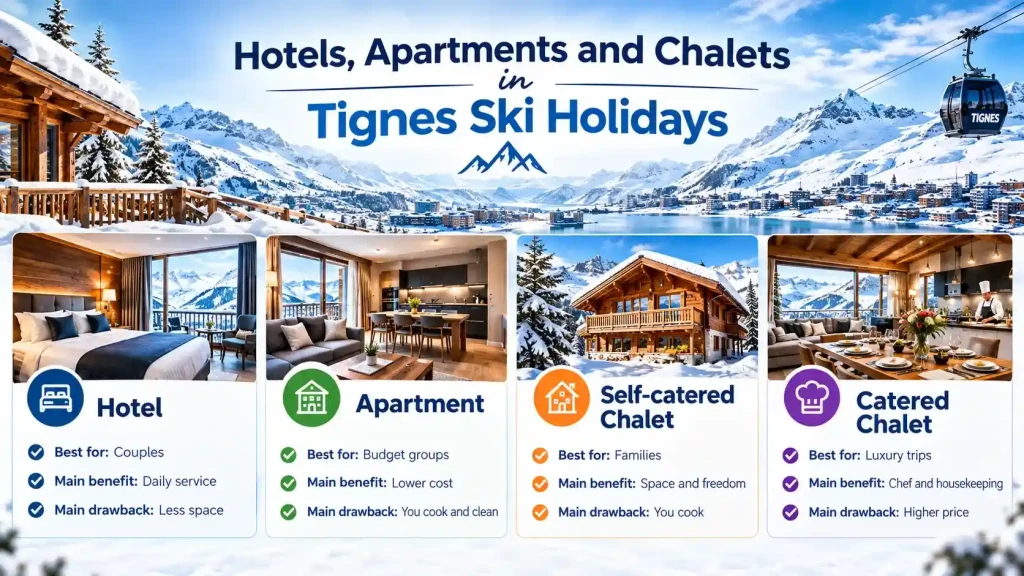
Hotels give you daily service and easy dining. Apartments give you flexibility and a lower price per person. Chalets give you space, privacy and a homely feel, which suits families and groups best. A catered chalet adds a chef and housekeeping, while a self-catered chalet lets you cook and eat on your own schedule.
| Type | Best for | Main benefit | Main drawback |
|---|---|---|---|
| Hotel | Couples | Daily service | Less space |
| Apartment | Budget groups | Lower cost | You cook and clean |
| Self-catered chalet | Families | Space and freedom | You cook |
| Catered chalet | Luxury trips | Chef and housekeeping | Higher price |
Choosing a Location
Ski-in ski-out stays save time because you click into your skis at the door. Stays close to Le Lac or Val Claret put restaurants and nightlife on your doorstep. Lower villages cost less and feel quieter, but they need more travel to the lifts.
Chalet Features Worth Paying For
A hot tub, a sauna or a cinema room turns evenings into a highlight, especially after a cold day on the slopes. A boot room with heated racks also makes mornings easier. Match features to your group, because a family with young children needs different things from a group of friends.
Getting to Tignes and Local Transport
Most visitors fly into Geneva or Chambéry, and some choose Lyon. From the airport, you can book a shared transfer, a private car, or a train to the valley followed by a bus. A private transfer costs more but saves time, especially for large groups. Inside the resort, shuttle buses link the villages in winter, so you can move around without a car.
Common Mistakes to Avoid
Many first-time visitors repeat the same errors. They book the wrong village, ignore the altitude, skip the snow report or arrive without a plan for ski lessons. Avoid these problems with a few simple habits. Pick a village that matches your evening style. Give your body a day to adjust to the altitude by drinking water and skiing easy runs. Read the weather and snow report each morning.
Book early for Christmas, school holidays and event weeks, because the best chalets in Tignes fill up first.
Expert Tips for a Smoother Holiday
Ski Lessons and Equipment
Book lessons before you arrive, especially in peak weeks. A guide also teaches you the mountain far faster than a map can. Rent equipment from a shop near your accommodation, and test your boots on the first day so you can swap them if they hurt.
Pace Yourself
Altitude tires some visitors in the first days. Drink plenty of water, limit alcohol on the first night and stop for a long lunch. You will ski better in the afternoons and enjoy the week more.
Conclusion
Tignes offers reliable snow, a vast ski area and a calendar full of events. The 2026/27 season looks especially exciting, with Mountain Shaker in January and the Para-Alpine World Championships in March. Study the weather pattern, read the snow report each morning, keep the piste map on your phone and choose a village that matches your style. Do that, and your Tignes ski holidays will run smoothly.
FAQs
When is the best time to visit Tignes?
January and February bring the deepest snow, while March offers longer, sunnier days. April suits skiers who prefer a quieter, spring-style trip.
Is Tignes good for beginners?
Yes. Gentle green and blue runs sit close to the villages, and ski schools teach all levels. The reliable snow also helps beginners practise on good surfaces.
Where can I find the Tignes piste map?
Download the official piste map from the resort website, pick up a paper copy at lift stations or the tourist office, and save a digital copy on your phone.
How big is the ski area?
Together with Val d’Isère, the ski area offers roughly 300 kilometres of pistes on one lift pass.
Do the 2026/27 events close the slopes?
No. Both events use specific venues, so normal skiing continues across the mountain. Check official resort updates before you travel.
Which village suits families best?
Le Lac offers shops, services and easy access, while Les Boisses and Les Brévières offer calmer stays. Pick the one that matches your group’s routine.
How can I check the weather and snow conditions?
Read the official snow report, watch the live webcams and check a mountain forecast every morning before you ski.